Ergogenics

  [Definitie:] "An ergogenic aid is any substance or phenomenon that enhances performance." (Wilmore and Costill)

  Nieuwsbrief over doping, supplementen, voeding en training

  Daniel Sarewitz       James Jughes       Thomas Murray       Volker Caysa    

2 7 - 0 1 - 2 0 0 4

Filosoof Andy Miah: Frankenrunner verdient een lintje

De mensheid loopt op zijn laatste beentjes en de toekomst is aan de cyborg: de mens die is versmolten met zijn technologie. Maar die onvermijdelijke toekomst loopt vertraging op omdat de samenleving bang is voor het onvermijdelijke. Gelukkig laat de sportwereld zien hoe het moet. Nou ja. De dopinggebruikers in de sport. Die laten zien hoe het moet.

Andy Miah

Dat zegt de Schotse filosoof Andy Miah in de Journal of Evolution and Technology. Miah is een posthumanist en een transhumanist. Hij gelooft dat de menselijke soort klaar is om een cruciale stap te zetten, en door nanotechnologie, cryotechniek en computertechnologie de beperkingen van zijn lichaam achter zich te laten.

Waarom nog op twee benen lopen, als de technologie ons een veel sneller lichaam kan geven? Waarom nog kijken met ogen, als we die kunnen vervangen door veel scherper monitoren? Waarom sluiten we onze hersenen niet aan op computers, zodat we meer weten en sneller kunnen denken? Waarom geven artsen ons geen vleugels, zodat we kunnen vliegen? We kunnen onszelf veel beter maken dan we zijn, als de samenleving geen raar idee had over de heiligheid van het lichaam, verzucht Miah.

Het conservatisme zit paradoxaal genoeg vooral in de hoek die het transhumanisme het meest zou kunnen helpen: de medische wetenschap. Artsen kunnen verschrikkelijk veel, maar richten zich volkomen op herstel van onze organen. Dat is prima, maar met diezelfde technologie waarmee we herstellen van brandwonden of botten genezen kunnen we onszelf ook verbeteren - en op dat punt laten artsen het collectief afweten.

Jammer, vindt Miah. En onlogisch. Want wat we nu als een ziekte beschouwen, gold een generatie eerder als iets wat gewoon bij het leven hoorde. Condities waar artsen nu niets aan willen doen zal een volgende generatie als ziekte beschouwen. Het onderscheid tussen herstel en enhancement is vaag en willekeurig.

Eigenlijk, zegt Miah, zijn artsen al lang begonnen met het opvoeren van de mensheid. Van nature worden we geen negentig jaar - dat komt door de medische wetenschap. Maar artsen vermommen hun kunnen als 'therapie'. Zo houden ze zichzelf en de samenleving voor het lapje en daardoor komt er veel minder uit de medische technologie dan eigenlijk mogelijk is.

De meest vooruitgeschoven sector van de medische wetenschap is volgens Miah de plastische chirurgie. De conservatieve medische technologie heeft dan wel het herstel van ons organisme tot een oud niveau van functioneren als norm uitgeroepen, als plastisch chirurgen een neus verfraaien is daar natuurlijk geen sprake van.

Miah hoopt dat het gebruik van plastische chirurgie ooit nog zo'n vlucht neemt dat mensen er wel naar moeten grijpen, omdat ze anders in de samenleving geen kans meer maken. Dat zal de acceptatie van de transhumanistische idealen goed doen.

Maar ook in de plastische chirurgie is Miah teleurgesteld. Echt buitenissige dingen komen er niet uit de operatiekamers gekropen, een enkele Amerikaans popidool uitgezonderd. Ook de plastische chirurgie blijft vasthouden aan het conservatisme. Neuzen verfraaien, dat vinden de chirurgen prima, maar als je vraagt ook een neus tussen je schouderbladen te monteren, dan kijken de dames en heren chirurgen je raar aan.

En daarbij: echt interessant wordt het natuurlijk pas als de mensheid ook zijn lichaam van binnen gaat veranderen. Aan supermenselijke vermogens heb je nu eenmaal meer dan een superaantrekkelijk uiterlijk.

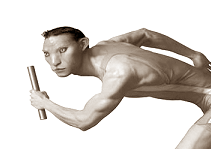
Dat veranderen van wezenlijke kenmerken gebeurt in de topsport. En daar, in dat milieu, ontstaat de mens van morgen, zegt Miah. De transhumaan, de posthumaan, de cyborg, dat is de atleet die records verbreekt. In de sport is het hinderlijke conservatisme vervangen door het Citius, Altius, Fortius van de Olympische beweging. Het gaat in de sport om het verleggen van grenzen, en daarvoor halen sporters alles uit kast: training, doping, voeding, uitrusting, analyses - alles.

O, ook in de sport zijn er krachten die de beloften van de technologie in de kiem willen smoren. De antidopingbeweging is Miah een doorn in het oog. Dat gaat maar tekeer tegen farmaceutische middelen - maar de argumenten die de antidopingbeweging daarvoor uit de kast haalt, die deugen van geen kant.

Doping zou kunstmatig zijn. Geklets, zegt Miah. Duuratleten sluiten zich soms op in kamers of tenten met weinig zuurstof om hun lichaam meer rode bloedcellen te laten aanmaken. En dat mag wel? Of die diëten en supplementen, die nauwelijks nog doen denken aan wat gewone mensen in hun mond stoppen.

Doping zou oneerlijk zijn. Onzin, vindt Miah. Sommige sporters zijn geboren met goede genen. Dat is ook niet eerlijk.

Doping zou niet getuigen van goed karakter. Een misdadige uitspraak, vindt Miah. Onze soort heeft genetische manipulatie nodig om verder te komen, en daarvoor zijn experimenten op mensen nodig. De eerste mensen die dat risico zulen nemen zijn de gentechsporters die straks op de velden zullen staan, en hun genen hebben veranderd om sneller te lopen. Die Frankenrunners zijn niet minder dan helden. Ze verdienen een medaille, geen veroordeling.

1. Andy Miah. Be very afraid: cyborg athletes, transhuman ideals and posthumanity. The Journal of Evolution and Technology 13 (2) October, 2003. [Link]
2. Andy Miah. Catching up with Frankenrunner. Spiked-Life, 2 april 2002. [Link]
3. Meer over Andy Miah vind je op www.andymiah.net. [Link]

Genetically modified athletes in Athens? Bring them on

We should welcome technological advances that can make superhumans, says Andy Miah

Sunday August 1, 2004
The Observer

What once seemed like science fiction has now turned into the worst possible nightmare for the World Anti-Doping Agency (Wada). The genetically modified athlete, it seems, is upon us - they might even be at this year's Olympics.

Ground-breaking medical research on mice and rats has demonstrated possible applications to sport. Geoffrey Goldspink at University College Medical School in London has developed a way of boosting muscle mass with the introduction of foreign, muscle-building DNA, while Lee Sweeney at the University of Pennsylvania has found similar results with his own research - and has been approached by athletes and coaches to use this technology in sport.

Their 'Schwarzenegger mice' studies have demonstrated up to 50-per-cent muscle growth when injected with muscle-boosting DNA. Their research was not meant to be applied to sport, but the possibility exists.

So, what should be our reaction to genetically modified (GM) athletes? Are we right to call them 'cheats'? Are we justified to ban them from playing sport? What if people are born genetically modified - would they be allowed to play sport? What if I am less genetically gifted than another athlete - should I be permitted to use gene doping to cancel out my disadvantage? And what about if I have been injured while participating in sport - would I be allowed to use gene therapy to quicken the process of repair?

These questions reveal that there is much more at stake here than just the ethics of sport and some fanciful notion of fair play or the 'natural' athlete.

Wada have already characterised genetic modification as another form of doping. But we would be far better off by permitting genetic modification in sport. It promises safer methods of enhancing performance than the use of synthetic drugs. This is a technology that athletes could learn to use effectively and safely and that would offer them far greater control over their bodies.

GM is consistent with the values of elite sport. We expect world records to be broken and we thrive on witnessing increasingly extraordinary performances. Genetic modification might not bring about a four-second 100 metres any time soon, but it would allow us to continue improving performances. And, where athletes are approaching their natural limits, GM offers a safe, healthy way of making such changes.

But sport also needs GM in order to shed light on the inadequacy of current anti-doping policies. The ethical basis of anti-doping has not been revised or questioned since it began in the 1960s. Sport has changed radically since then and technology is now integral to an athlete's achievement. But why are ethical debates about technical equipment and doping entirely separate in the world of sport? The use of altitude chambers is a good example to show how complicated these discussions are. Why are these chambers permitted? How are they different from practices on the prohibited doping-methods list?

Gene doping offers a way out for Wada as it faces criticism that its aggressive testing strategies are ineffective. If Wada permitted gene doping, they would be better placed to offer athletes a safer way of enhancing their performance.

This is preferable to having athletes genetically modify themselves behind closed doors, which seems inevitable. By describing genetic modification as doping, Wada limits itself considerably and overlooks the very principles upon which anti-doping policy has been developed.

They also perpetuate the fear of genetic modification that has plagued this technology. GM athletes will not look like grotesque monsters. They will look very similar to athletes we already see at the Olympics - who already seem super-human to most of us.

Gene doping is inevitable and impossible to avoid, and allowing it should not be seen as giving up on the doping war. It should be seen as a critical and responsible way of dealing with performance in sport.

It is pitiful that we undermine an athlete's contribution to society when they test positive for some minute, ridiculous substance. It is shameful that we put athletes through the humiliation of testing and condemnation when they return a positive test. They are legally vulnerable and drug testing encourages us to treat them as objects, which we can toss aside when they do not meet the standards of behaviour we have set for them. If we permitted genetic modification, we might realise that what remains within a sporting accomplishment is not diminished. Athletes will still need to train hard, perhaps even harder.

We cannot afford to leave decisions about genetic modification to the world of sport. Without a critical engagement on this matter, we might have sporting bodies deciding who gets to play sport and who doesn't, based on their genetic profile.

There is no mistaking that this issue is rife with controversy and emotion, but we need to replace these superficial impressions with considered understanding about how these technologies would be used. Genetic enhancement could make us more robust, more capable and better humans. Genetically modified athletes might actually arise from just trying to make healthier people. It would be wrong not to pursue this technology and sport will need to find ways of integrating such people. GM asks us to question what it means to be human. Nobody said that this is going to be easy to deal with. It challenges fundamental assumptions about our place in the world and our influence on nature.

Yet sport needs to realise that a moral crusade is misplaced. Permitting gene modification is not 'giving up' on sport ethics. It does not mean endorsing drugs. It is an assertion of our inherent, technological identity. We stand to gain a lot and we lose very little. We have played God for centuries.

Dr Andy Miah is author of 'Genetically Modified Athletes: Biomedical Ethics, Gene Doping and Sport', published by Routledge.

[Link]

Navigatie

Nieuws

Contact

Over ons

Dossiers

Zoeken